
Overview
While digital tools connect people more than ever before, these connections are often shallow and transactional. Social media fosters visibility, not intimacy; networking events prioritize professional gain, not belonging. As a result, millions of early-career professionals and students struggle to find consistent, values-aligned, wellness-centered community that helps them thrive personally and emotionally. During this 5-week design jam, our team worked to create a solution to this modern-day epidemic.
Role
Product Designer
Team
Faith, Product Manager
Lucy, Business Analyst
Grace, Technical Architect
Anastasia, UX Generalist
Timeline
5 Week Design Jam
Tools
Figma
Lovable
Google Suite
Skills
Mobile App Design
Survey Design
Rapid Prototyping
The Problem
Nearly half of adults report feeling lonely, and one in three young people say they often feel left out. Transient life stages, like moving to new cities for work or school, exacerbate the problem. Studies show that 63% of adults ages 18-29 have moved away from their hometown, often leaving behind built-in networks of family and friends.
How might we connect young adults to promote wellness goals and improve accountability?
The Process
Over a five-week sprint, we moved from problem identification to a high-fidelity MVP:
Week 1: Problem Statement + Personas
Week 2: Solution Ideation + Customer Discovery
Week 3: Mid-Fi Wireframes, Competitor Analysis, and Pricing Strategy
Week 4: Hi-Fi Wireframes and Brand Integration
Week 5: Final Deliverables
Understanding Our Users
This problem especially affects early- to mid-career adults, graduate students, and young professionals who have relocated for school or work and are seeking meaningful, balanced lives in new environments. So, we decided to come up with different personas to embody our problem space.
Jade (24) - A young professional craving connection and structure while trying to build healthy habits.
Sam (28) - A graduate student adjusting to a new city who’s surrounded by people but lacks depth in his relationships.
Bri (32) - A wellness leader who builds community for others but struggles to sustain her own network and support.
Malik (30) - A remote worker and former athlete seeking accountability, camaraderie, and personal growth.
Our Primary Persona
Jade recently moved to New York City for work. Between long days at her nonprofit and trying to rebuild her social circle, she’s craving consistency in her wellness routine and in her friendships. She loves trying new things (Pilates, walking meet-ups, journaling nights), but most community events feel either too formal or too shallow. She wants to find “her people”. People who genuinely want to grow together, not just network or go out.
Jade Winters

Community-Driven
Age: 24
Young Professional
Desires
-> Wellness challenges that feel fun and supportive, not competitive.
-> Intimate, welcoming small groups built around shared interests.
-> To reduce the number of apps she has to download
Pain points
-> Feels disconnected and overwhelmed by big-city loneliness.
-> Tired of social events centered around drinking or work talk.
-> Struggles to stay consistent with self-care habits.
Research
Competitive Analysis
Comparing our app to popular fitness and wellness competitors, we were able to confirm our app's uniqueness in its framing of goals and habits through a growth and wellbeing mindset.

Survey Design
We deployed a short survey to further investigate the behaviors and needs of our target users.
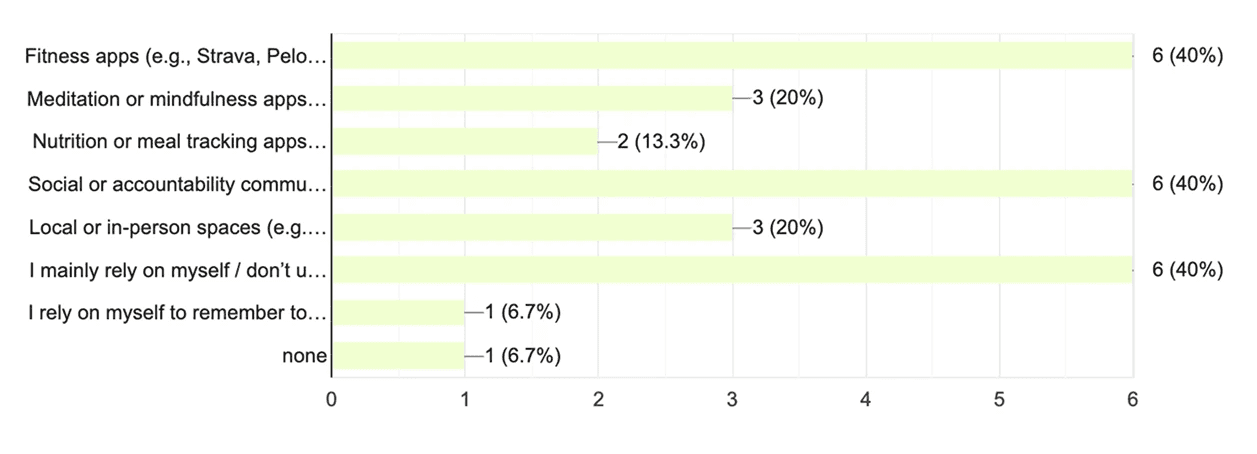
Challenges After Significant Life Transitions
There is a "loneliness epidemic" exacerbated by the fact that 63% of young adults move away from their hometowns, leaving behind established support networks. This suggests our design should prioritize social intimacy and belonging rather than just transactional goal-tracking.
Multiple Apps for Single Functionalities
Lack of Connection and Authenticity in Habit Tracking
It is vital that users feel a sense of "psychological safety" within their digital communities to share progress and setbacks. Gamification and leaderboards can be helpful in habit formation, but may deter those who are vulnerable about personal goals relating to wellness.
Design
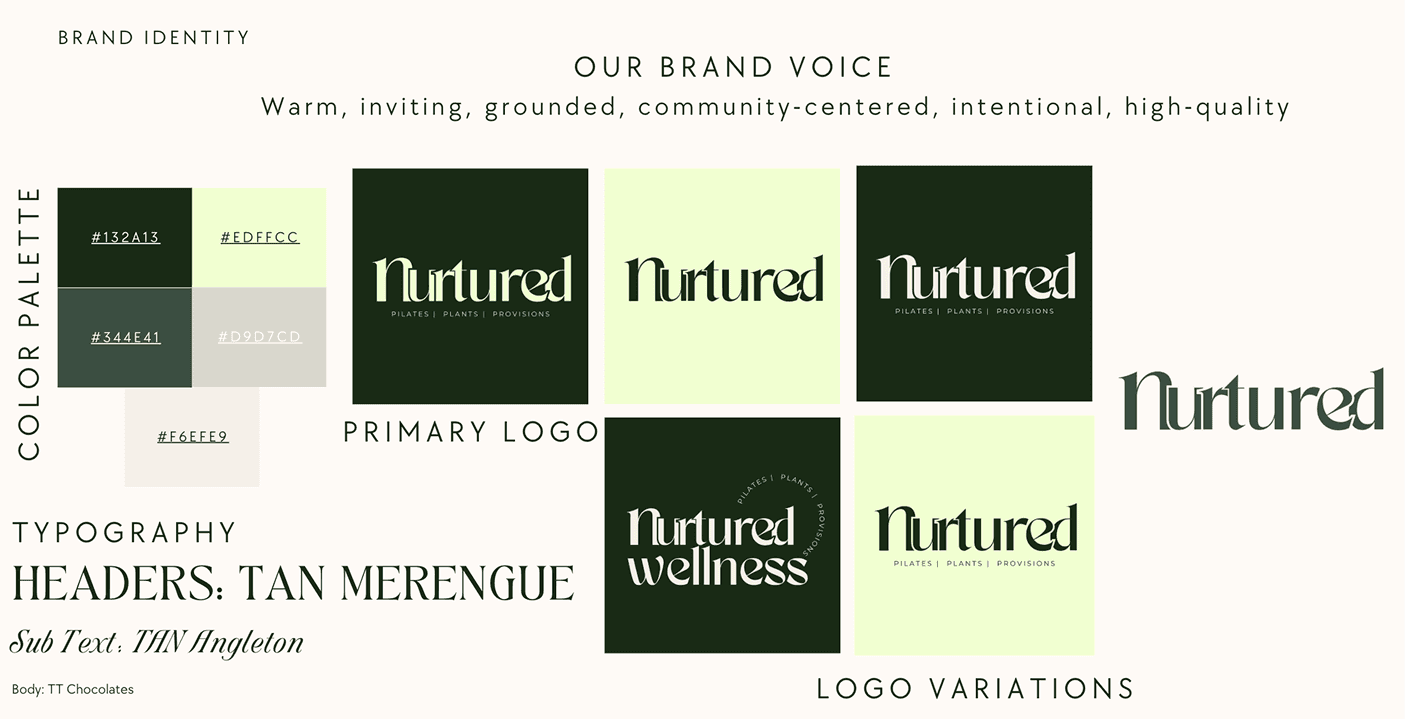
Working with a startup branding guide, I focused on a warm, inviting, and uplifting aesthetic. I introduced Orange into the palette to represent energy and warmth; psychological studies link the color to increased motivation and goal-oriented behaviors. From mid-fidelity wireframes to high-fidelity prototypes, we focused on creating a purposeful and growth-focusing digital wellbeing space for our users.
The Solution
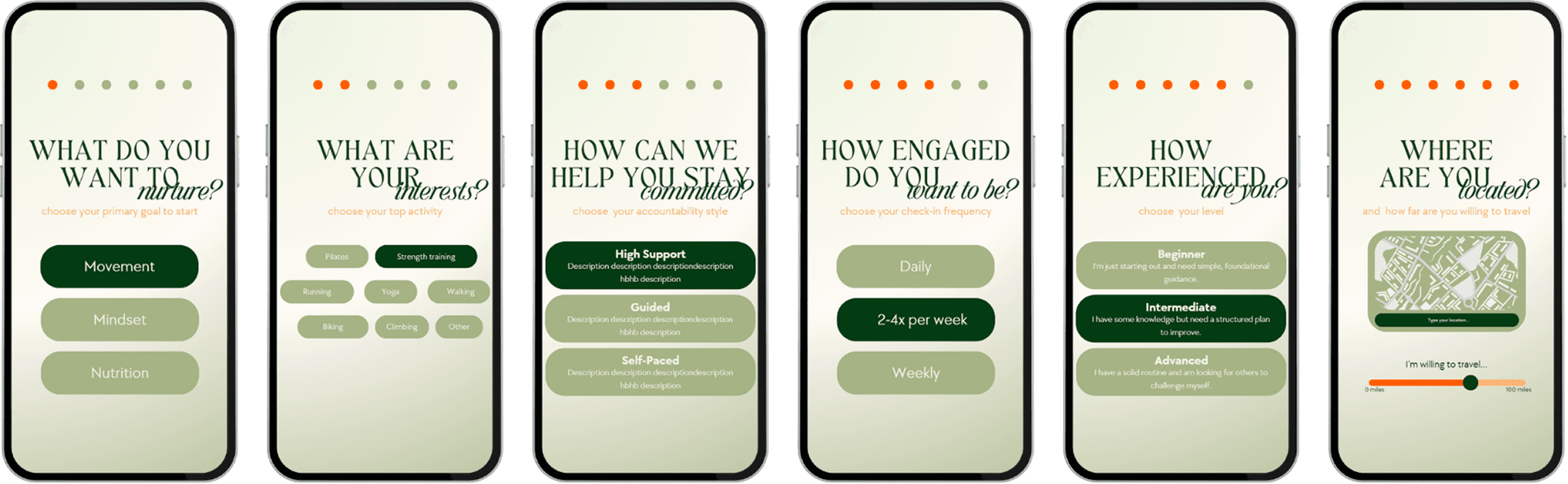
Match users with a warm, community-centered platform to find values-aligned "pods" that nurture real-world wellness and accountability
Algorithmic Pod Matching
Our application uses intelligent matching to connect users with a wellness "pod" based on shared goals, interests, and geographic location. This bridges the gap between digital interaction and real-life community, specifically for those in new cities.

Guided Accountability Styles
To ensure the experience is accessible to everyone, users can choose their preferred support style: High-Support, Guided, or Self-Paced. This personalized approach reduces the "burden" of traditional social apps by allowing users to engage at their own comfort level.
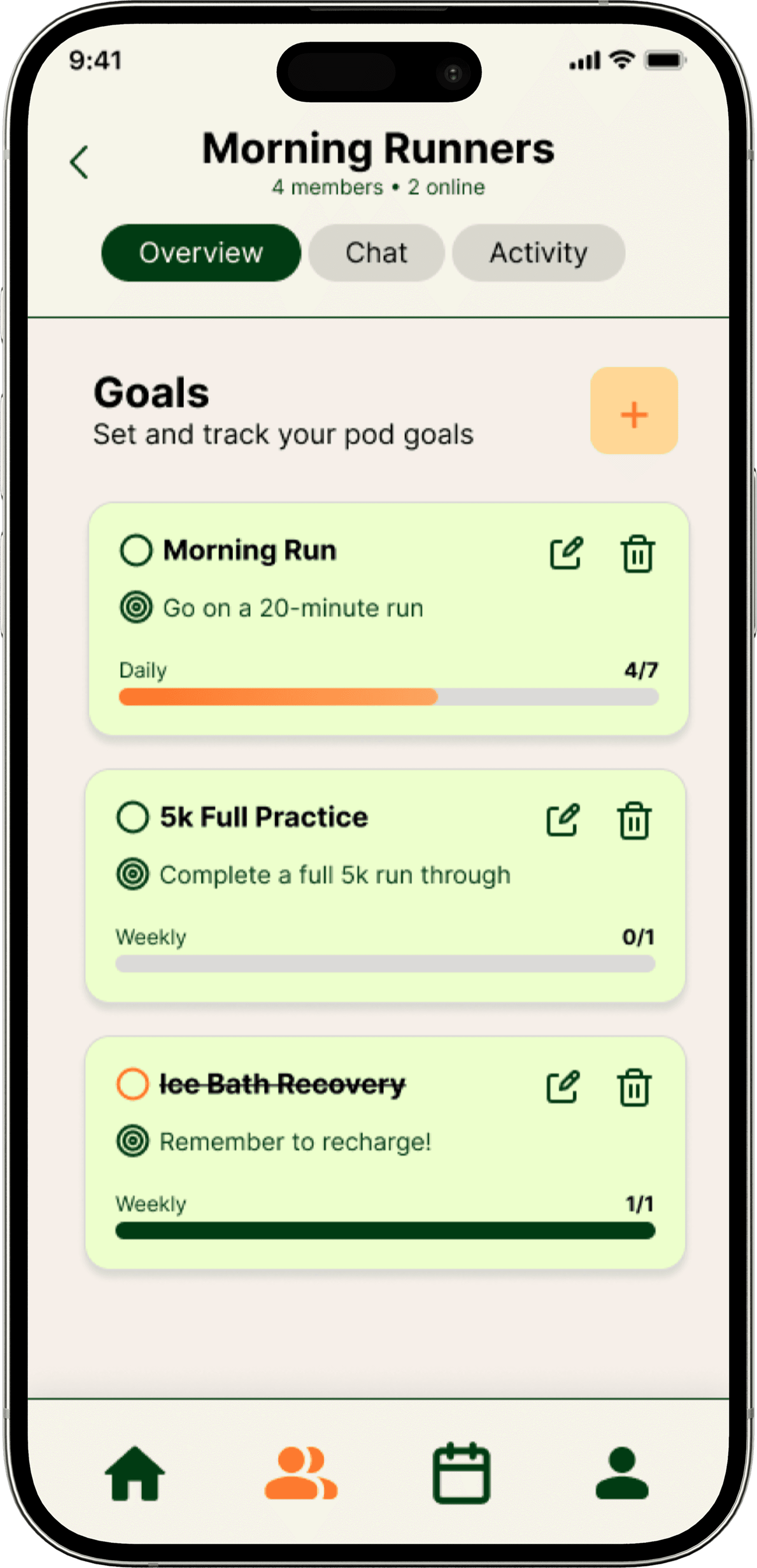
Nurtured Pods & Shared Dashboard
Users can visualize progress as a group through a shared dashboard. By seeing and interacting with the activity of "pod-mates," the app transforms individual habits into a collective journey. Users can chat, edit group goals, and celebrate wins in a familiar, intuitive framework.



An All-in-One System
From chatting with pod-mates, settings goals, planning events, and tracking analytics, Nurtured Pods is intended to be an all-encompassing app to reduce the burden of switching between single-functionality platforms. Users are able to progress, learn, and grow with their pods all within the app, featuring event calendars, personal statistics, and check-ins.


What I Took Away
Design is Not Linear
Identifying the scope of the problem early is crucial. With such a short timeframe to research, ideate, and design our solution, we dove into feature scoping early in the process. We initially looked at wellness broadly, incorporating aspects of nutrition, health data, and reflections, but found that our ideas were too much for a minimal viable product. After iterating through wireframes and speaking with subject matter experts and business professionals, we narrowed our scope by solving the specific pain point of social isolation in early-career professionals.